

Blog
Lung cancer has many threads. Understanding them matters.
Publication date: 11.02.2026
Most people think of lung cancer as one disease. We often talk about diseases in the singular. It makes complex topics easier to discuss, but it can also obscure important differences – especially in cancer. We take a closer look at these differences to push science further for people with lung cancer.

Understanding the different threads of lung cancer and listening to people living with the disease is fundamental to how we approach lung cancer research and development. We believe that a disease this diverse requires different treatment approaches to address it from multiple angles. So, what are the different “threads” that make up lung cancer – and how do they influence our science?
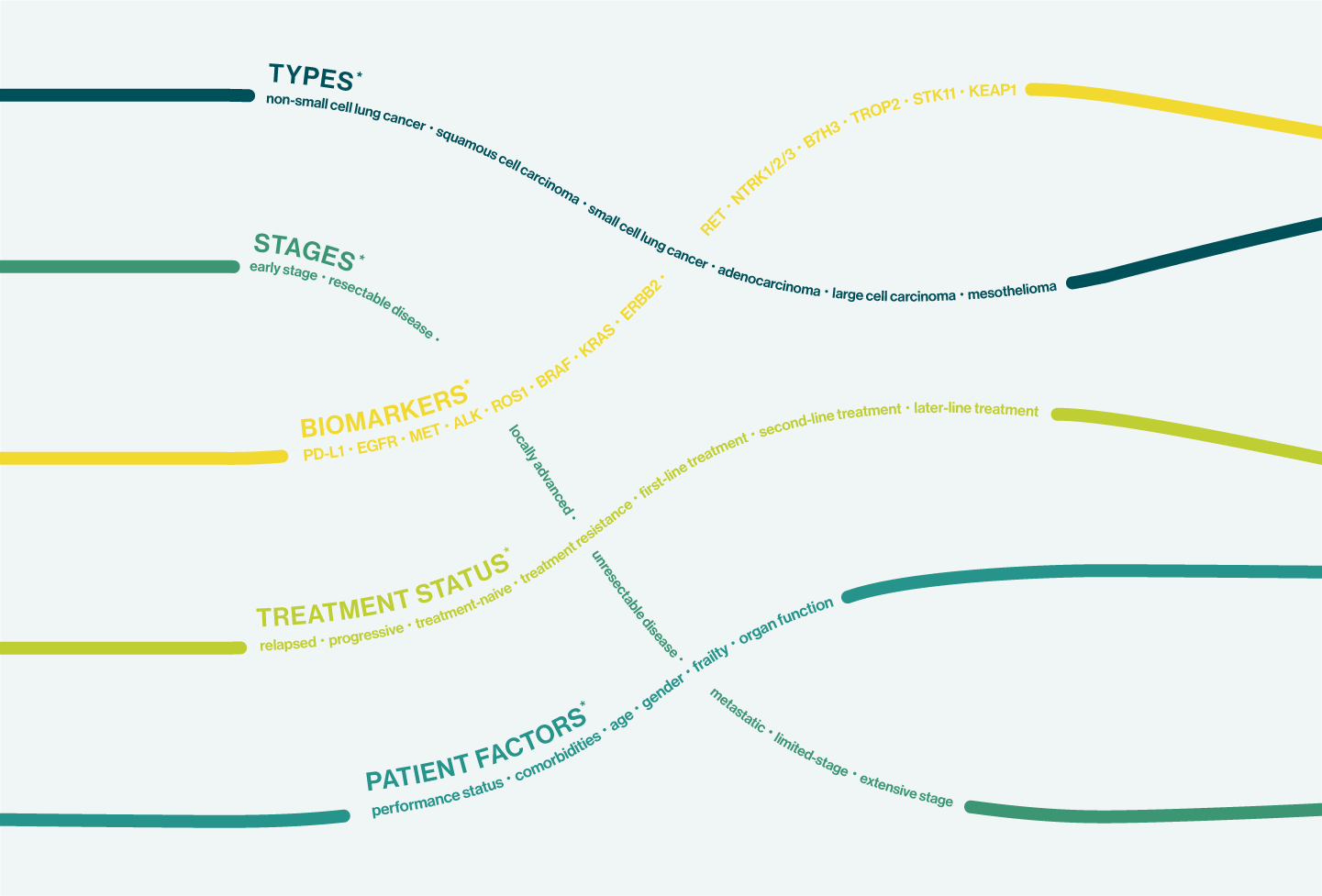
The overview of categories on this image is not exhaustive and is intended to illustrate the complexity of lung cancer.
1) Why do different types of lung cancer matter?
Two people can both have lung cancer and yet be facing different types of disease.
Lung cancer includes several types and subtypes. The main types are non-small cell lung cancer (NSCLC) and small cell lung cancer (SCLC).1 NSCLC itself includes subtypes such as adenocarcinoma and squamous cell carcinoma.1
A closer look at lung cancer types and subtypes:
Small Cell Lung Cancer
Non-Small Cell Lung Cancer
Adenocarcinoma
Squamous Cell Carcinoma
These distinctions matter because different types and subtypes of lung cancer have different characteristics that can influence how the disease develops and which treatment approaches may be considered.2 They can also help reveal where there is an important unmet medical need. This is where we focus our work.
2) Why does stage of disease matter?
What patients need from treatment can differ depending on whether their lung cancer is early stage, locally advanced, unresectable, or metastatic.3 Treatment considerations can also change if the cancer returns or progresses following treatment.4
As lung cancer progresses, it can become more difficult to treat,5 and patients may have few options left. The right approach at one stage or point of a patient’s experience may not work, or be the right approach, later on.
A closer look at the stages of lung cancer:
Early-stage lung cancer
Locally-advanced lung cancer
Unresectable lung cancer
Metastatic lung cancer
Ananya Bhattacharya, Senior Director, Global Medical Affairs at BioNTech: “We work in some of the most challenging areas of cancer treatment. For people with squamous cell lung cancer whose disease progresses after initial therapy, treatment options remain limited, with little progress seen over the past decade.6 We want to change that and focus on developing new options where the medical need is greatest.”

“We work in some of the most challenging areas of cancer treatment. For people with squamous cell lung cancer whose disease progresses after initial therapy, treatment options remain limited, with little progress seen over the past decade.6 We want to change that and focus on developing new options where the medical need is greatest.”
3)Why are biomarkers important in lung cancer?
Two tumors can look similar but behave differently at the molecular level. Even within the same type or subtype of lung cancer, tumors can differ biologically.7
Biomarkers are measurable characteristics of a tumor or its surrounding environment.7 They can provide important information about a tumor and what treatment approaches may be most appropriate. Some may point to potential treatment targets, while others can reveal how a tumor interacts with the immune system.7
These differences are another reason we do not think of lung cancer as a single disease. We consider the diverse biological and clinical realities of lung cancer. Following this thread means finding ways to better target tumors with treatment and address how they grow or evade the immune system.
4) Why is treatment status an important part of understanding lung cancer?
Lung cancer can change over time. As the treatment journey and disease progresses, tumors may develop different ways to resist treatment.8
Therefore, progress in lung cancer treatment also depends on exploring how different approaches can solve different treatment challenges across the treatment journey. This is why we are evaluating multiple approaches.
Prof. Ilhan Celik, M.D., Vice President Clinical Development at BioNTech: “Lung cancer remains one of the most complex cancers and no single treatment can address every facet of the disease. That is why we are developing treatment approaches with complementary mechanisms of action that may work together to address different needs across the continuum of the disease.”

“Lung cancer remains one of the most complex cancers and no single treatment can address every facet of the disease. That is why we are developing treatment approaches with complementary mechanisms of action that may work together to address different needs across the continuum of the disease.”
5) Why do patient factors matter beyond the tumor?
Understanding a tumor is only part of understanding lung cancer. Behind every diagnosis is an individual with their own health, treatment history, priorities, and goals.
Progress therefore means asking more than what an investigational treatment does to a tumor. It also means understanding what patients need from treatment and what a meaningful advancement could mean in the context of their lives and care.
Developing new therapies must be a collaborative effort. Patients, caregivers, patient advocates, healthcare professionals, and clinical investigators each bring perspectives that deepen our understanding of lung cancer and inform the development of our medicines and clinical trials. This is why every innovation that we pursue is guided by their needs and perspectives from the earliest stages onward.
Following the threads towards more possibilities
Every thread matters. The many differences in lung cancer can shape how the disease develops and responds to treatment. Understanding them is essential to continue to drive innovation for people living with lung cancer.
Lung cancer research is one of the most active areas in oncology. Over recent decades, research has brought new treatment options and better outcomes for many people. We want this to become a reality for more people living with this disease.
We believe that the next generation of innovations in lung cancer treatment will come from looking more closely at the many facets of the disease and tailoring treatment approaches to them.
At BioNTech, we are doing so by exploring the many threads of lung cancer with one of the most diverse clinical pipelines in the field. Because behind each thread is a person waiting for better options.
Explore more



1 American Cancer Society. What is Lung Cancer? https://www.cancer.org/cancer/types/lung-cancer/about/what-is.html. Accessed November 5, 2026.
2 Centers for Disease Control and Prevention. Treatment of Lung Cancer. https://www.cdc.gov/lung-cancer/treatment/index.html. Accessed November 5, 2026.
3 American Cancer Society. Non-small Cell Lung Cancer Stages. https://www.cancer.org/cancer/types/lung-cancer/detection-diagnosis-staging/staging-nsclc.html. Accessed November 5, 2026.
4 American Cancer Society. Treatment Choices for Non-small Cell Lung Cancer, by Stage. https://www.cancer.org/cancer/types/lung-cancer/treating-non-small-cell/by-stage.html. Accessed November 5, 2026.
5 US Preventive Services Task Force. Final Recommendation Statement on Lung Cancer Screening: Importance. https://www.uspreventiveservicestaskforce.org/uspstf/recommendation/lung-cancer-screening. Accessed November 5, 2026.
6 National Comprehensive Cancer Network. Non-small cell lung cancer (Version 9.2026). www.nccn.org/professionals/physician_gls/pdf/nscl.pdf. Accessed November 5, 2026.
7 Passaro A., et al. Cancer Biomarkers – Emerging Trends and Clinical Implications for personalized treatment. Cell. 2024:187(7):1617-1635.
8 Ashrafi A., et al. Current Landscape of Therapeutic Resistance in Lung Cancer and Promising Strategies to Overcome Resistance. Cancers. 2022:14(19); 4562.


